Installing Custom Extensions
Overview
Next Design allows you to use not only official extensions but also user-developed extensions by packaging them.
The following explains how to install custom extensions in the following order:
- Add a package source
- Install the extension
- To package an extension, refer to Quickstart > Common > Distribution via Package Function in the Extension Development Manual.
- Do not install an extension if you do not trust the creator, as this may affect security.
Adding a Package Source
A package source is the location where packages are placed. To easily install custom extensions from the Next Design menu, you need to add them beforehand on your Next Design installation.
The following two environments can be added as package sources:
- Server: Specify the URL of a server set up by the user.
- Local Folder: Specify the folder where the extension's package files will be located.
To add a package source, follow these steps:
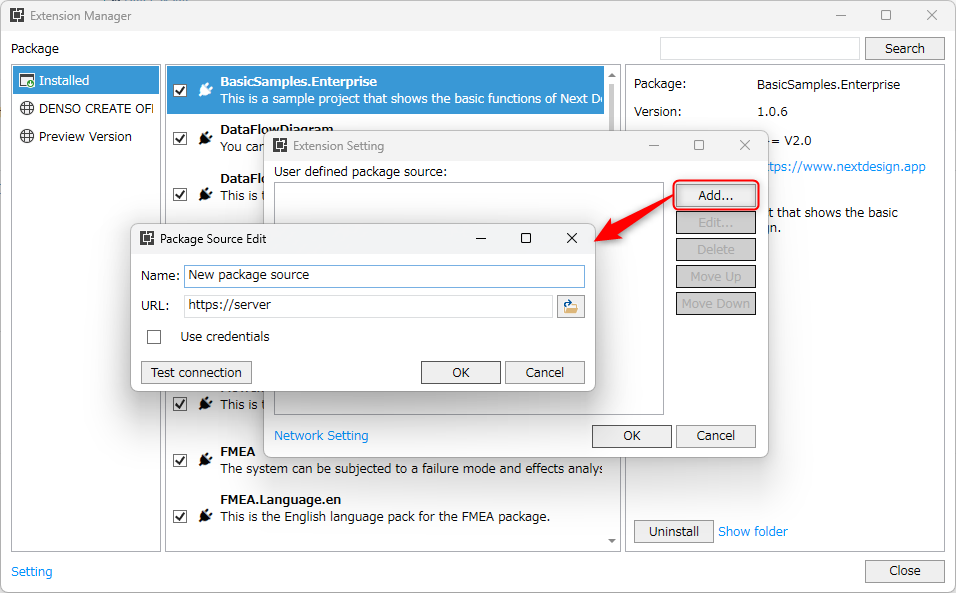
- In the [Packages] dialog, click the [Setting] link in the lower left to open the [Extension Settings] dialog.
- Click the [Add] button to open the [Edit Package Source] dialog.
- Enter a name of your choice in [Name].
- Enter the server address or folder path where the extension's package will be retrieved in [URL] and click the [OK] button.
- The added package source will appear in the list on the left.
- Selecting the added package source will display a list of installable extension packages.
-
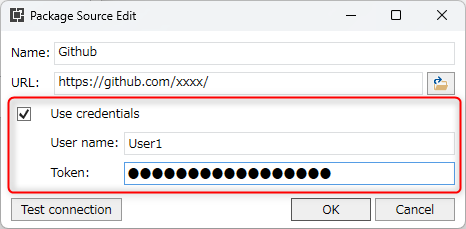
If you specified a server address in the URL, you can set credentials.
-
Check the [Use Credentials] checkbox and enter your [User Name] and [Token].
-
Credentials can be used with GitHub and GitLab.
- If you add a local folder that does not have the extension package file directly under it as a package source, the installable extension packages will not be listed.
Installing Extensions
To install user-developed extensions in your Next Design, select the added package source from the list on the left side of the [Packages] dialog.
- For specific installation instructions, see Installing Official Extensions > Installing Extensions.
Troubleshooting
Depending on the error message, try the following solutions:
Unauthorized (401 Error)
- Verify that your user authentication information for accessing the package source URL is correct.
Forbidden (403 Error)
- Verify that your proxy settings are correct and that there are no network restrictions such as firewalls.
Not Found (404 Error)
- Verify that the URL and folder path you set in the [Add Package Source](#Add Package Source) procedure are correct.