Basic View Definition
Overview
In Next Design, you can define multiple views for each entity. Newly added entities only have a form-style [Detail] view defined.
There are two methods for defining a View Definition:
-
Define a view in the Model Editor for fields and relationships already defined in the metamodel.
-
Define a view in the Model Editor simultaneously with adding entities, fields, and relationships to the metamodel.
The former method is recommended when defining a view for the target metamodel for the first time, or when you are not familiar with the structure of that metamodel. Therefore, this manual will only explain the former method.
The following explains the basic methods for defining views for entities in the following order:
- Add a View Definition
- Duplicate a View Definition
- Edit a View Definition
- Delete a View Definition
- Change the View Order
- Enable Document Output for Views
- For information on the types of views that can be defined, please refer to the following:
Adding a View Definition
To add a new view definition for an entity, follow these steps from the Model Editor:
- For instructions, please refer to the following:
Duplicating a View Definition
To duplicate an existing view definition for an entity, follow these steps from the Profile Navigator:
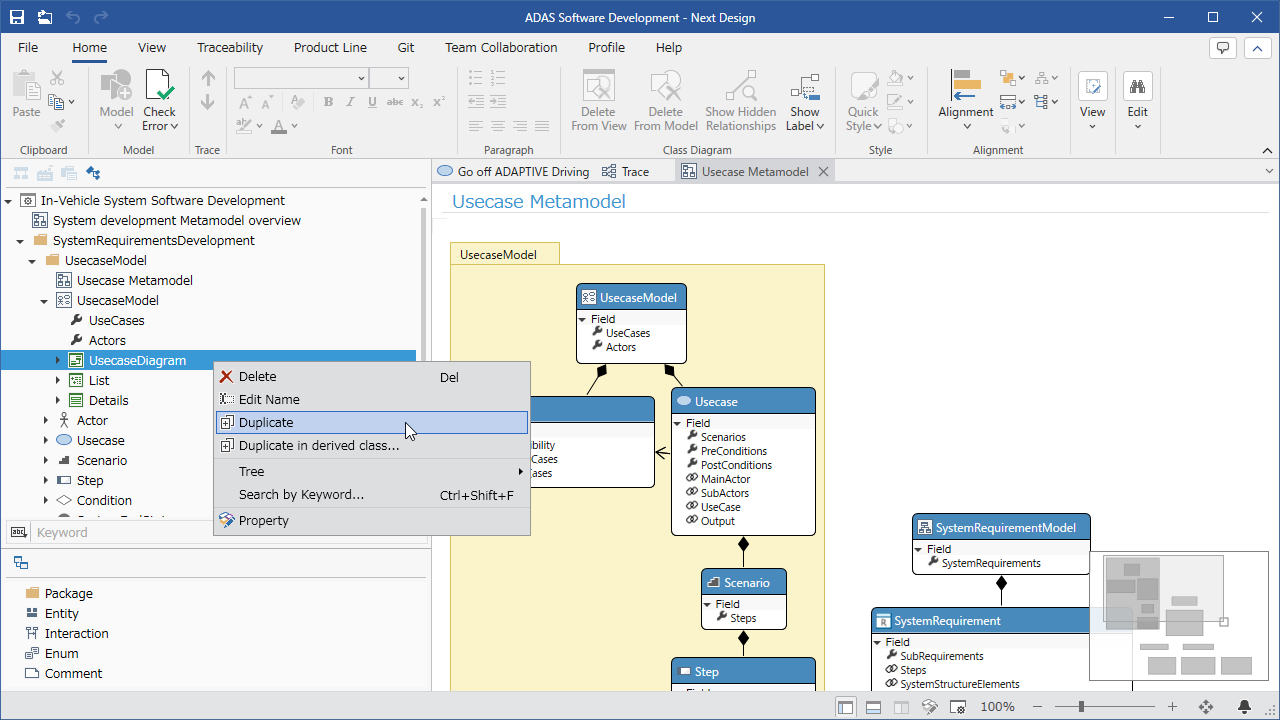
:::note: Instructions
- Switch to [Profile Navigator] using the selector at the top of the navigator.
- Identify the entity containing the view definition you want to duplicate in the Profile Navigator. (See [Use case] in the image above)
- Expand the tree under that entity. The view definitions belonging to that entity will be listed at the end of the child nodes. (See the three in the image above: [Usecase Diagram], [List], and [Detail])
- Select the child node with the same name as the view definition you want to duplicate and click [Clone] from the context menu. (See [Usecase Diagram] in the image above)
- After duplication, the duplicated view definition will be added under the selected view definition.
:::
:::tip: Reusing View Definitions from Inherited Entity
Among entities with an inheritance relationship, the derived entity can duplicate and use the view definition of the inherited entity.
To duplicate the view definition of the inherited entity, follow these steps:
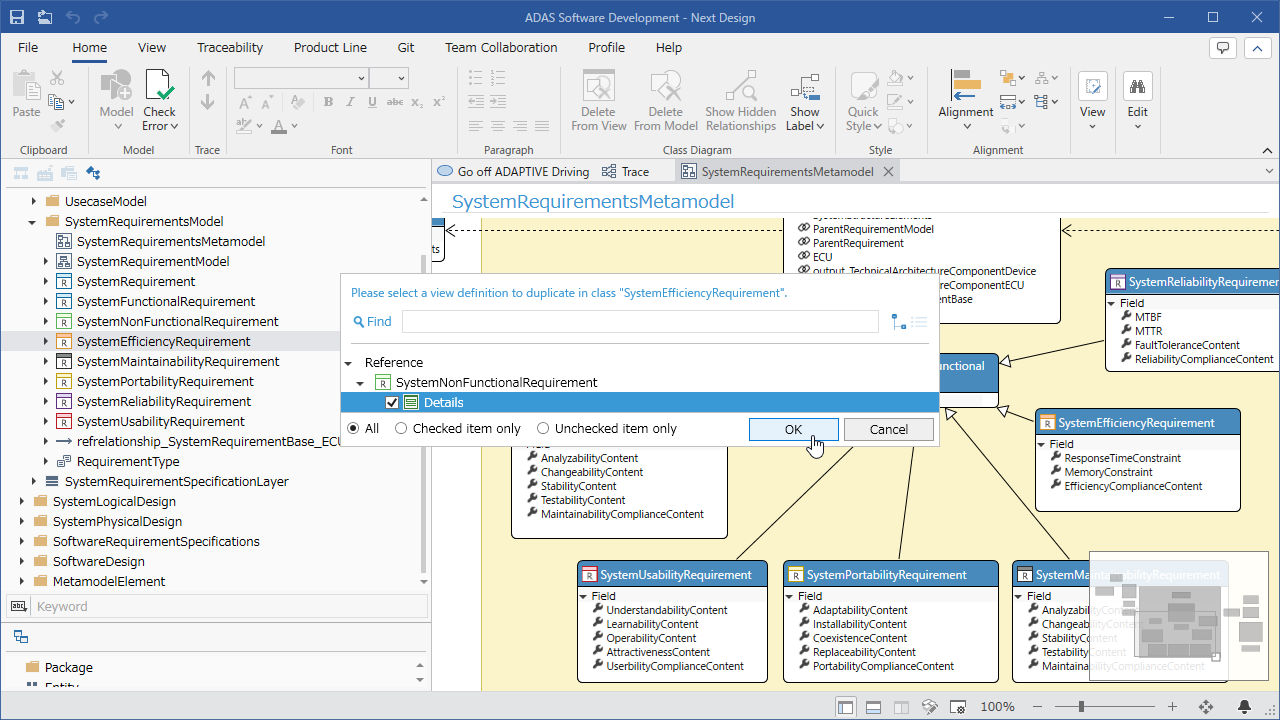
Operational Procedure
- Switch to [Profile Navigator] using the selector at the top of the navigator.
- Identify the derived entity in the profile navigator. ([Efficiency requirement] in the image above)
- Click [Add] > [View Definition] > [Duplicate from inherited class] from the context menu to display a dialog box.
- From the list of duplicable view definitions displayed in the dialog box, select the view definition you want to duplicate ([Non-functional requirements] > [Detail]) and click the [OK] button.
- The duplicated view definition will be added to the selected derived entity.
:::
- The source and destination view definitions are not synchronized. If you want to incorporate changes to the view definition of the source view into the destination view, delete the destination view definition and then duplicate it again.
- View definitions may have extensions that extend their display/operation. Please note that if you duplicate such a view definition, the extension-based extensions will not work in the destination view.
Editing View Definitions
Editing view definitions is explained separately for each type of view.
- ER Diagram View Definition
- Tree Diagram View Definition
- Tree Grid View Definition
- Form View Definition
- Sequence Diagram View Definition
Deleting View Definitions
To delete an existing view definition, follow these steps from the Profile Navigator:
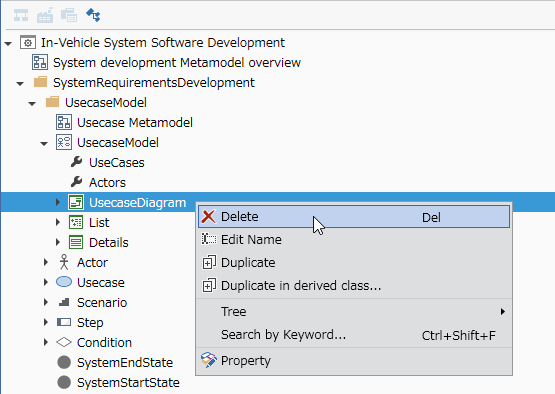
- Switch to [Profile Navigator] using the selector at the top of the navigator.
- Identify the entity with the view definition you want to delete in the Profile Navigator. (The [Use case] in the image above)
- When you expand the tree under that entity, the view definitions that the entity possesses are listed at the end of the child nodes. (The three in the image above: [Usecase Diagram], [List], and [Detail])
- Select the child node with the same name as the view definition you want to delete and click [Delete] from the context menu. (The [Usecase Diagram] in the image above)
- Once deleted, the corresponding view will be removed from all models corresponding to that entity.
Changing the View Order
To change the order of the toggly views lined up in the upper right of the model editor, follow these steps from the Profile Navigator:
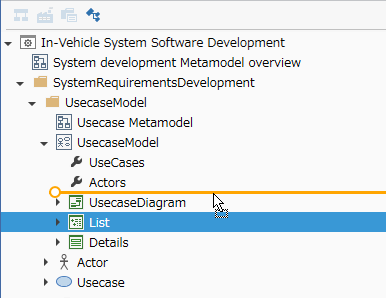
- Switch to [Profile Navigator] using the selector at the top of the navigator.
- Identify the entity that has the view definition you want to change in the Profile Navigator. (See the image above for [Use case])
- When you expand the tree under that entity, the view definitions associated with that entity are listed at the end of the child nodes. (See the image above for [Usecase Diagram], [List], and [Detail])
- Click to select the view definition whose order you want to change, and then drag and drop it to swap its order with other view definitions. (See the image above for [List])
- When you change the order of view definitions on the Profile Navigator tree, the view order will be changed for all models corresponding to that entity according to that order.
View Document Output Eligibility
To set whether to output views when generating documentation, follow these steps:
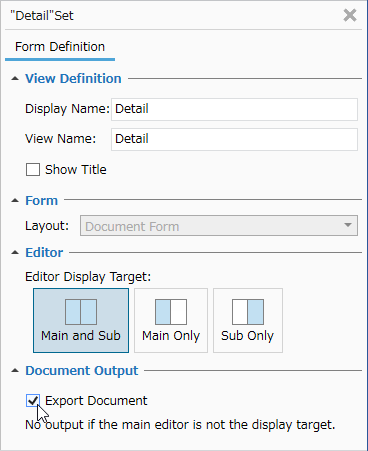
- Switch to [Profile Navigator] using the selector at the top of the navigator.
- Select the entity with the view definition on the Profile Navigator.
- Click [View] > [Pane] > [Inspector] on the ribbon to display the Inspector.
- Toggle the checkbox for [Document Output] > [Export Document] in the Inspector.
Views whose view definitions cannot be edited (e.g., sequence diagrams) cannot be configured and will always be output to the document.
- When generating a document in Word/PDF format, you can output tree grids and diagrams to separate files.
Outputting to separate files allows for better visual confirmation of large tree grids and diagrams.
- For information on how to output to separate files, see [Modeling > Document Generation > Document Generation Overview > Document Generation Option Settings](../../modeling-guide/document-generation/overview#Document Generation Option Settings).